Dearborn Grease Trap does grease trap cleaning for Wyandotte kitchens, from the locally owned restaurants and gastropubs on Biddle Avenue to the smaller dining rooms around them. Our crews work out of Dearborn and come to your back of house, open the trap, clear it and leave you with the paperwork. If your drain is slow, your kitchen smells, or you want a schedule so neither happens, this page explains how the work goes and what it costs.

Call before the trap fills up
Tell us about your kitchen and we will say what service fits it. Call (313) 351-8079, and the person on the phone will ask what you cook, how often you fry, and where the trap sits.
What Wyandotte's kitchens are like
Downtown Wyandotte's dining is built around Biddle Avenue, where locally owned gastropubs and restaurants sit close together. The social district keeps those rooms full on weekends and event nights. These are mostly independent kitchens in older buildings with compact back-of-house space. Most run a small indoor trap under a prep sink or near the dish station, not a large buried interceptor out back.
That is why interior grease trap cleaning is the core work here. A small indoor trap holds little, and a busy Friday and Saturday fills it fast. Fryers, flat-tops, dish machines and pot sinks all send grease toward the same small box. When it is full, the grease and solids go on into the drain line, and that is where backups and smells begin.
Some larger buildings do have exterior interceptors. We pump those too, and the section on price covers them. For most Wyandotte restaurants, though, the visit is an interior trap visit.
Featured job: a Biddle Avenue gastropub
Chapter 1: the Saturday slow drain
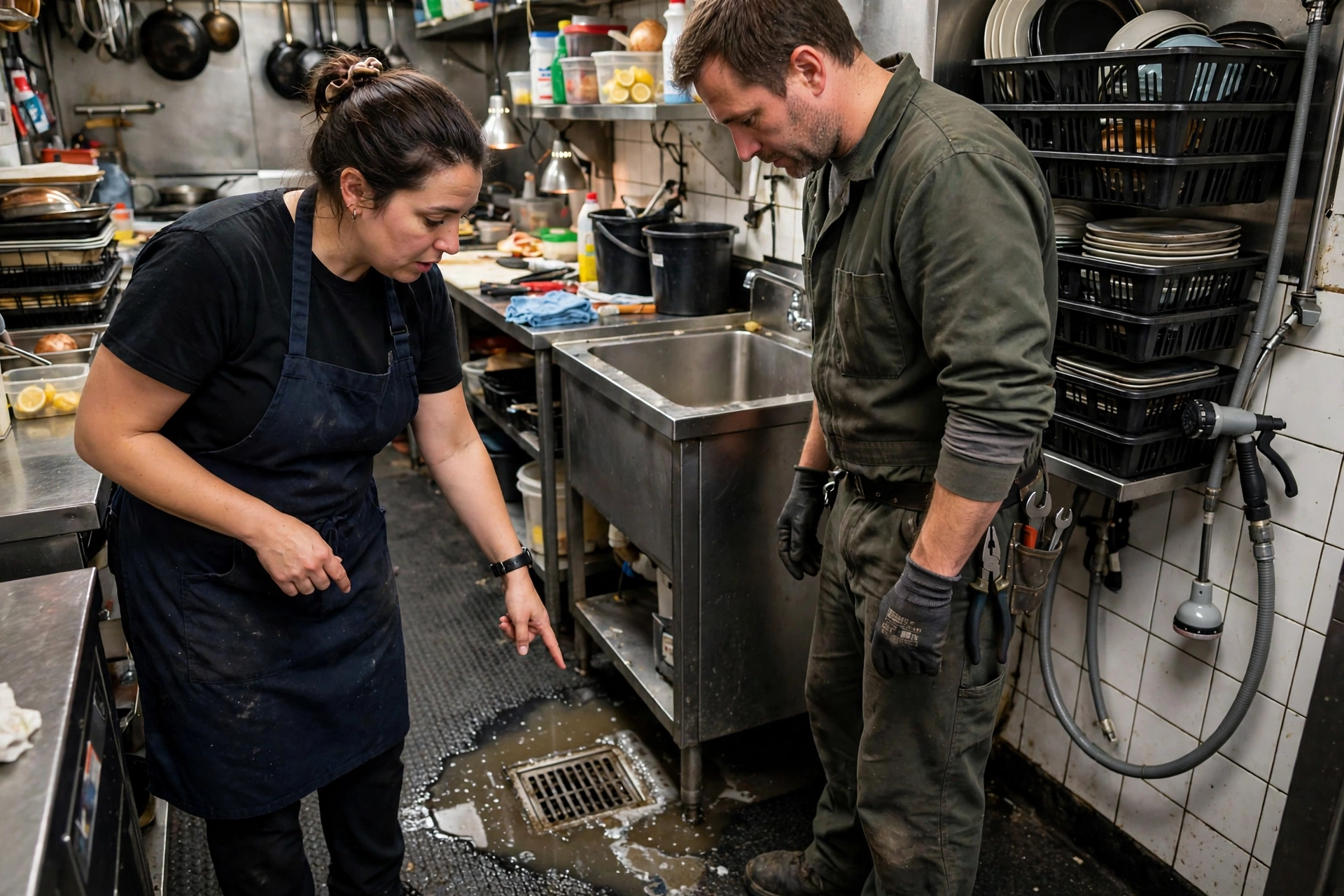
A gastropub on Biddle Avenue called us on a Monday. The kitchen manager said the floor drain by the dish station had run slow all through Saturday service and a sour smell had come up behind the line. The kitchen runs a fryer, a flat-top and a busy dish pit, and the room is full whenever the social district is busy. Nobody could say when the trap had last been opened.
Chapter 2: opening the trap
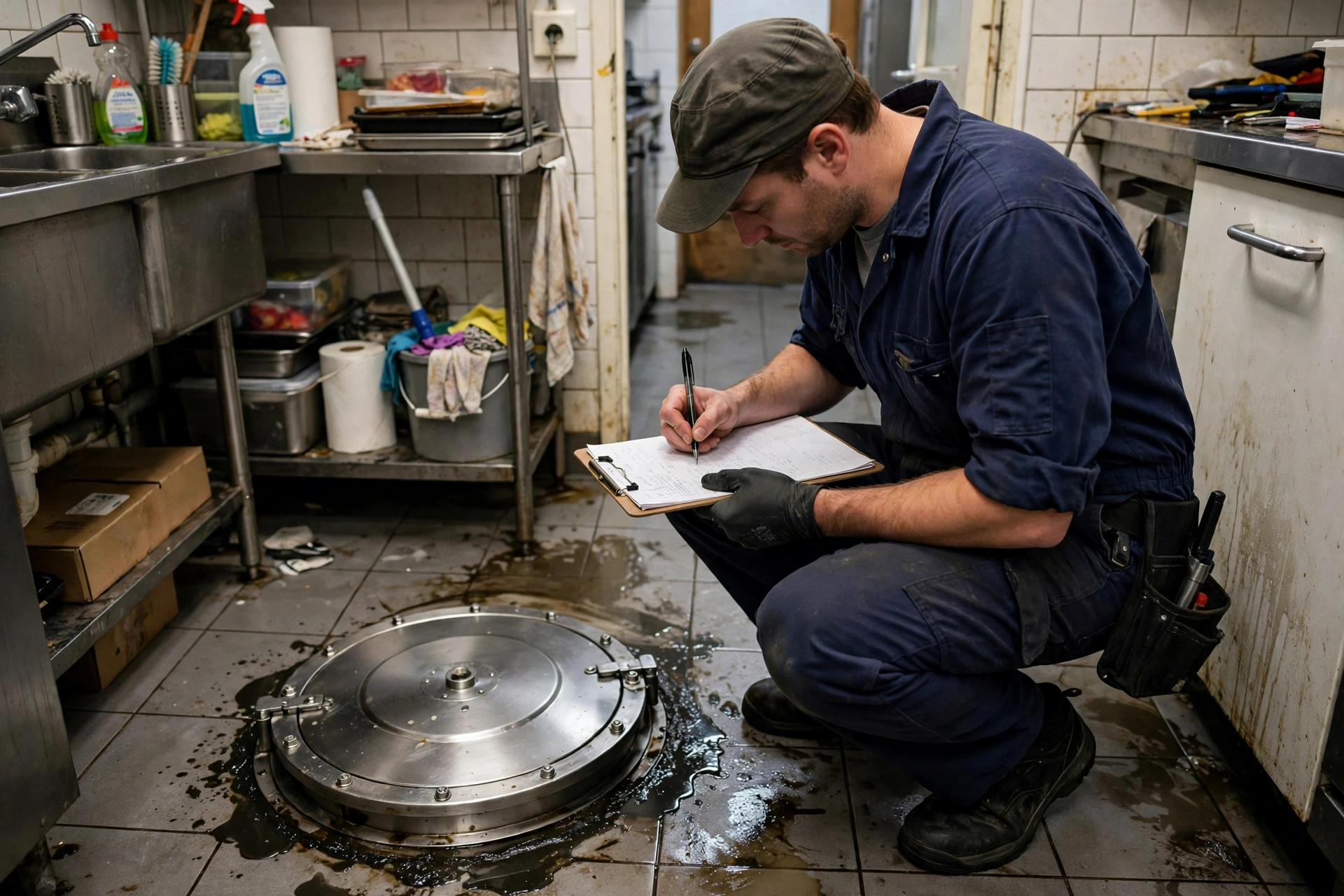
Our crew found a small indoor trap under the prep area, behind a cabinet. The lid came up on a thick cap of grease with solids packed beneath. The crew checked it against the trade's working benchmark: when grease and solids together reach about a quarter of the trap's capacity, it is time to pump. This one was well past that. The benchmark is trade practice for scheduling, not a rule from the city.
Drag the handle in the figure below to compare the trap as we found it with the trap after cleaning.
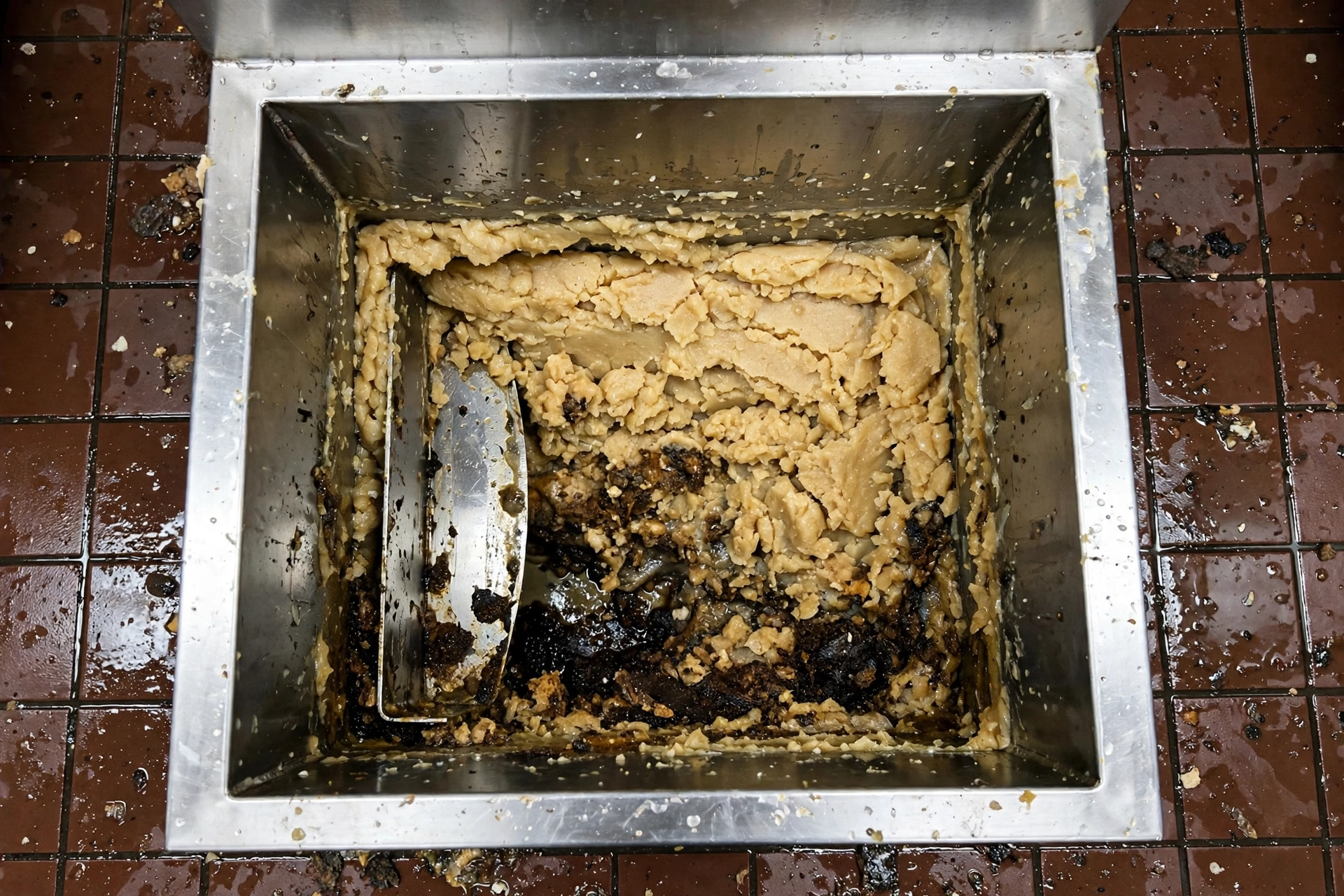
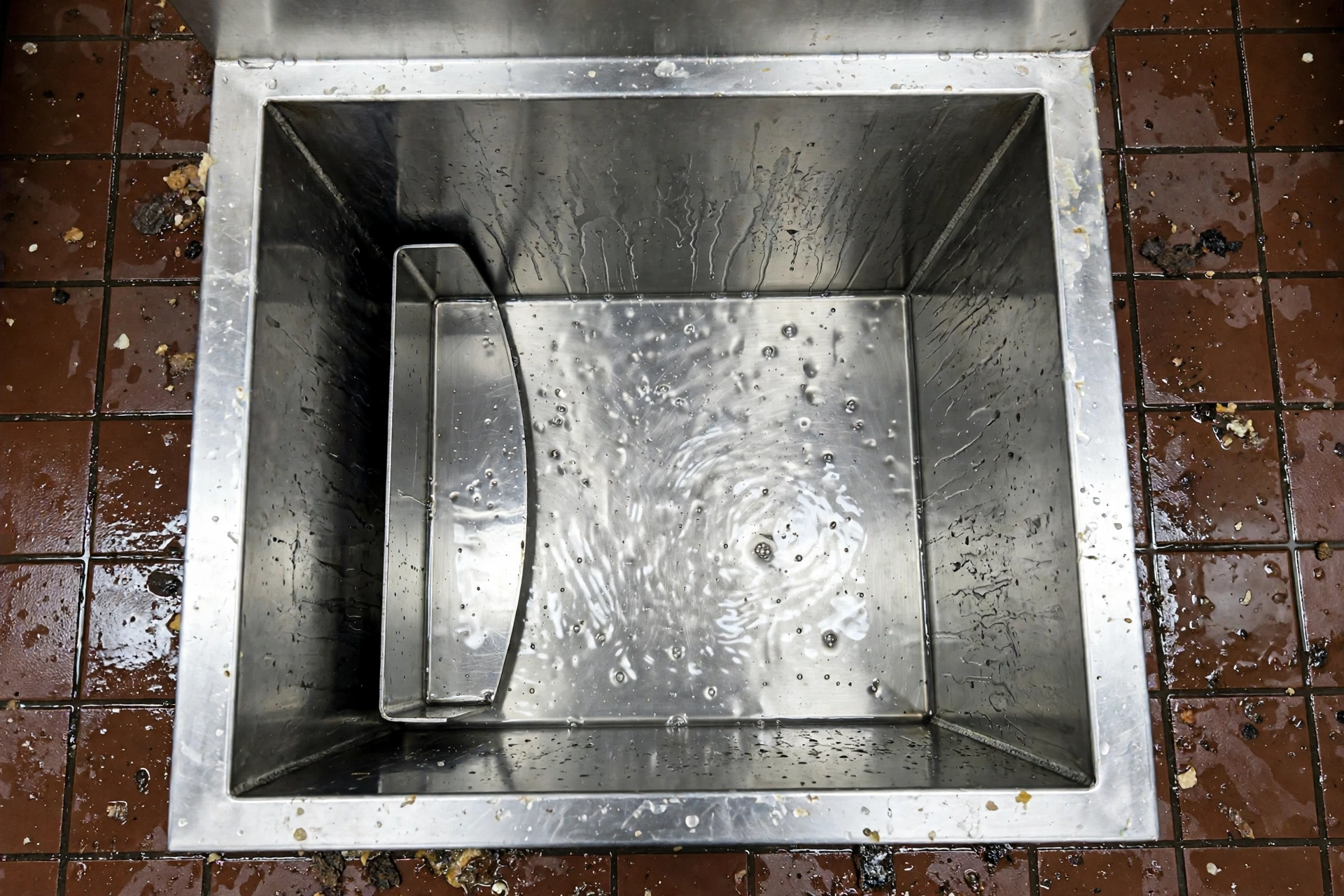
The quarter-of-capacity point is a trade scheduling benchmark, not a law and not a Dearborn or Wyandotte rule.
The removed grease and solids go out with a licensed hauler on a shipping document, because Michigan treats trap waste as a liquid industrial by-product.
A small indoor trap is priced from $150 to $350.
The customer keeps a service record from the visit.
Chapter 3: out, documented, scheduled
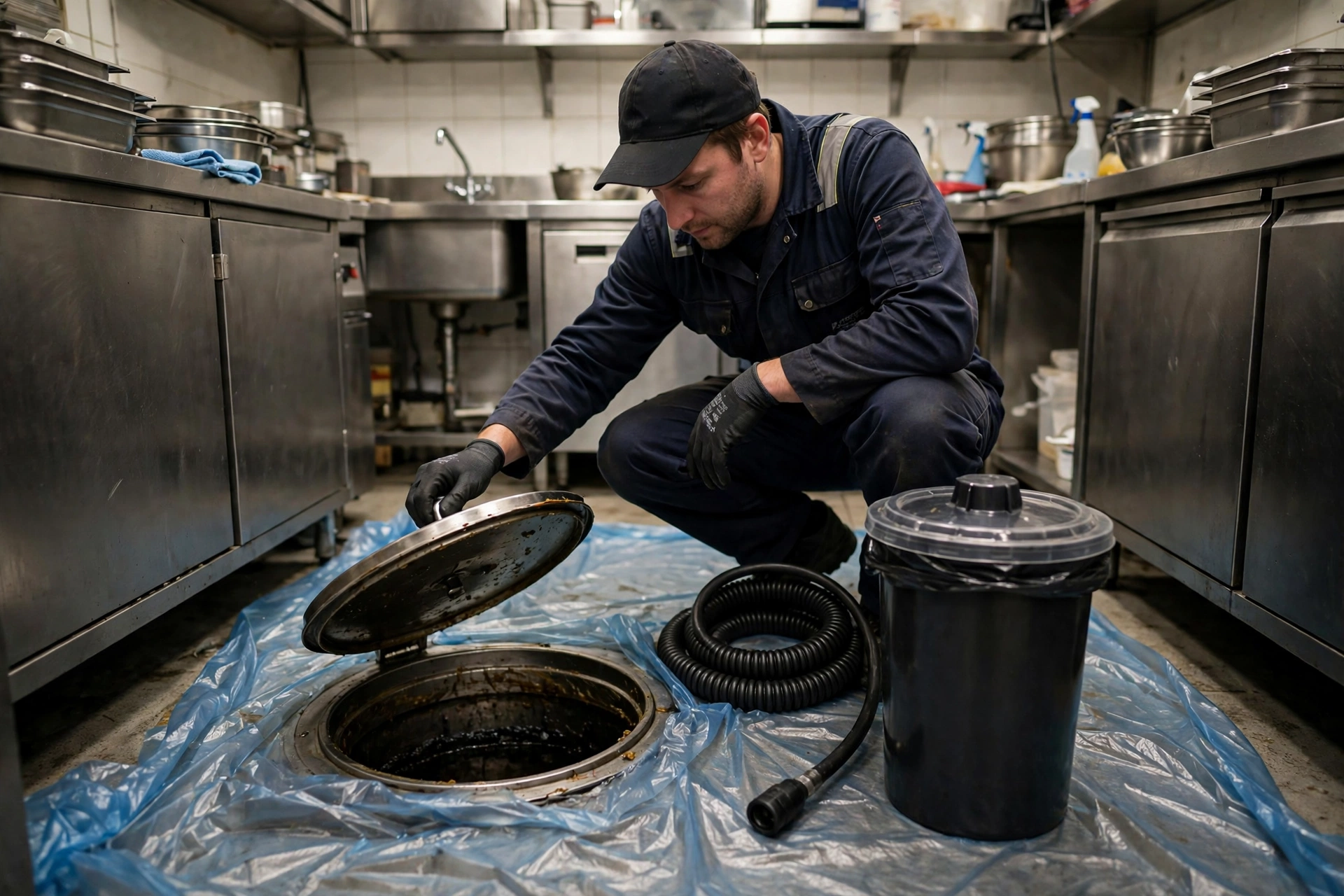
The crew pumped out the grease cap, liquid and sludge, scraped the interior walls and cleared the baffles. They checked the lid, the inlet and the outlet for wear. The waste left with us on a shipping document, which is how Michigan's Part 121 rules treat this material. The kitchen manager got a service record showing what was done.
We then talked through how fast this kitchen fills its trap, based on what we saw. The pub cooks fried food and runs a full dish pit, so we set a rhythm that fits it and told the manager to call if the drain slowed between visits. The cleaning of the trap fell in the small indoor range of $150 to $350.
How the service runs for a Wyandotte kitchen
1. You call. We ask what you cook, how many covers you run, where the trap is and how long since it was last opened. 2. We schedule around service. We plan the visit for a time that stays out of your rush. 3. The crew opens and measures. We check the grease and solids against the quarter-capacity benchmark. 4. We pump and clean. Grease cap, liquid and sludge come out, the interior is scraped, baffles are cleared and the parts are checked. 5. The waste leaves legally. It goes with a registered hauler on a shipping document. 6. You get your records. You keep the service record, ready for any inspection or notice.
What the visit includes, what we document, what you keep
- Included: removal of the grease cap, liquid and sludge, scraping of the interior, clearing and inspection of the baffles, and a check of the lid, inlet and outlet.
- Documented: the condition of the trap, what was found, what was removed, and the shipping document for the waste.
- You keep: the service record and your copy of the shipping paperwork.
What governs the work
Dearborn has no FOG ordinance with a trap-sizing table, a fixed pumping interval or a restaurant manifest rule. Dearborn's own code limits grease in discharge to 1,500 mg/L, which is Dearborn's rule and not a Wyandotte one. Wyandotte's own local sewer rules are not stated on this page, so check with your city's utility office on what applies to your building. What applies everywhere in Michigan is Part 121: trap waste is a liquid industrial by-product that only a registered hauler may move, on a shipping document, and the restaurant keeps its own copies.
Price
These are our prices for grease service.
| Service | Price |
|---|---|
| Interior grease trap cleaning, small indoor traps | $150 to $350 |
| Medium traps | $300 to $600 |
| Large exterior interceptors | $500 to $1,000 or more, by capacity and waste volume |
| Emergency call-out | One and a half to two times the standard service price |
| Used cooking oil collection | No charge for clean oil |
Line jetting is priced with the service visit it rides with. The price of a visit is set by the size of the trap, how hard it is to reach and how much waste comes out. A trap in a tight cabinet or a long hose run costs more than one by the back door.
Mid-page invitation
Not sure which size your trap is? Call (313) 351-8079 and describe where it sits and what it looks like. We will tell you which price range fits your kitchen before anyone is scheduled.
When to call
The floor drain by the dish station is slow, or water stands after the pot sink empties.
A sour smell comes up from a drain behind the line.
You cannot remember when the trap was last opened.
A health inspector or a sewer authority has asked for your cleaning records.
You are opening a kitchen and want a schedule from the start.
A backup has already happened. That is the emergency call-out.
Working frequencies in the trade run from every 4 to 6 weeks for high-volume kitchens to every 3 to 6 months for low-volume ones. Those are what kitchens actually run, not requirements. Winter guidance from a provider that serves Dearborn says grease congeals as temperatures drop, so traps need checking more often in the cold months, not less.
Questions
Do I need grease trap cleaning if my drains are running fine?
A trap can fill well before a drain slows. The trade's benchmark is to pump when grease and solids reach about a quarter of the trap's capacity. Call us and we will help you judge what that means in your kitchen.
How often should a Wyandotte restaurant have its trap cleaned?
No fixed interval is set in the rules we teach here. In practice, high-volume kitchens run every 4 to 6 weeks and low-volume kitchens every 3 to 6 months. Your fryer load and covers decide where you fall.
Is the quarter-capacity rule the law?
No. It is the trade's scheduling benchmark. It is not a Dearborn rule, a Wyandotte rule or a state rule.
Does Dearborn's grease limit apply to my Wyandotte kitchen?
The 1,500 mg/L limit is in Dearborn's own code and applies there. Wyandotte's own local rules are not stated here, so ask your city's utility office what applies to your building.
What does state law say about the waste?
Under Michigan's Part 121, trap clean-out residue is a liquid industrial by-product. It may only be hauled by a registered and permitted transporter, on a shipping document for each shipment. The restaurant keeps its own copies.
What does a small indoor trap cost to clean?
Interior grease trap cleaning for small indoor traps is $150 to $350. Medium traps are $300 to $600.
What if I have an exterior interceptor?
We pump those as well. Large exterior interceptors are $500 to $1,000 or more, by capacity and waste volume.
What does an emergency call-out cost?
An emergency call-out is one and a half to two times the standard service price.
Will you close my kitchen to do the work?
We plan the visit around your service so the crew stays out of your rush. The trap is opened, cleared and closed while the rest of the kitchen stays in order.
What records do I get?
You keep a service record and your copy of the shipping document for the waste. Records of cleaning and maintenance are what a sewer authority may ask to see.
Can you take my used cooking oil?
Yes. Used cooking oil collection is no charge for clean oil. In winter, oil can freeze in outdoor bins, and the fix is a bin swap.
Do you do line jetting?
Yes. Line jetting is priced with the service visit it rides with.
Final invitation
Call (313) 351-8079, or send the form below. Name and phone are required. Everything else is optional, and a consent box is required before you send it.
The more details you give, the better we are able to help you.