Dearborn Grease Trap handles grease trap cleaning for the restaurants, cafés and bars of downtown Plymouth, driving out from Dearborn to pump, scrape and document the small indoor traps that sit under prep sinks and dish lines. If your kitchen has a slow drain, a sour smell at the floor drain after close, or a trap nobody can remember opening, this page explains how the work goes and what it costs. The prices are ours and they are printed below.
Location · Plymouth
Call before the backup
If you already have a slow line or a smell, call (313) 351-8079 and tell us what the kitchen is doing. If you are setting up regular service so the problem never arrives, call for that too. Either way, a short conversation about your trap and your menu is where the plan starts.
Location · Plymouth
Plymouth's kitchens and why interior traps are the work here
Plymouth's downtown is a walkable dining scene: restaurants, cafés and bars close together, many of them in older buildings with compact back-of-house space. Kitchens like that rarely have room for a large in-ground tank. They run a small grease trap indoors, usually near the dish sink or the prep sink, and that trap does all the catching before the wastewater leaves the building.
A small trap fills fast relative to its size. A busy Friday of fried food, pan scrapings and dish soap can move the grease cap and sludge layer a long way in a few weeks. Because the unit is small, it is also easy to forget. It sits behind a cabinet door or under a floor plate, and it works silently until it doesn't.
Interior trap cleaning is a short, contained visit. The crew works at the unit, usually without closing the kitchen. The grease cap, liquid and sludge come out, the interior is scraped, the baffles are cleared and checked, and the lid and fittings are looked over. That is the work most Plymouth kitchens need, and it is the service this page is built around.
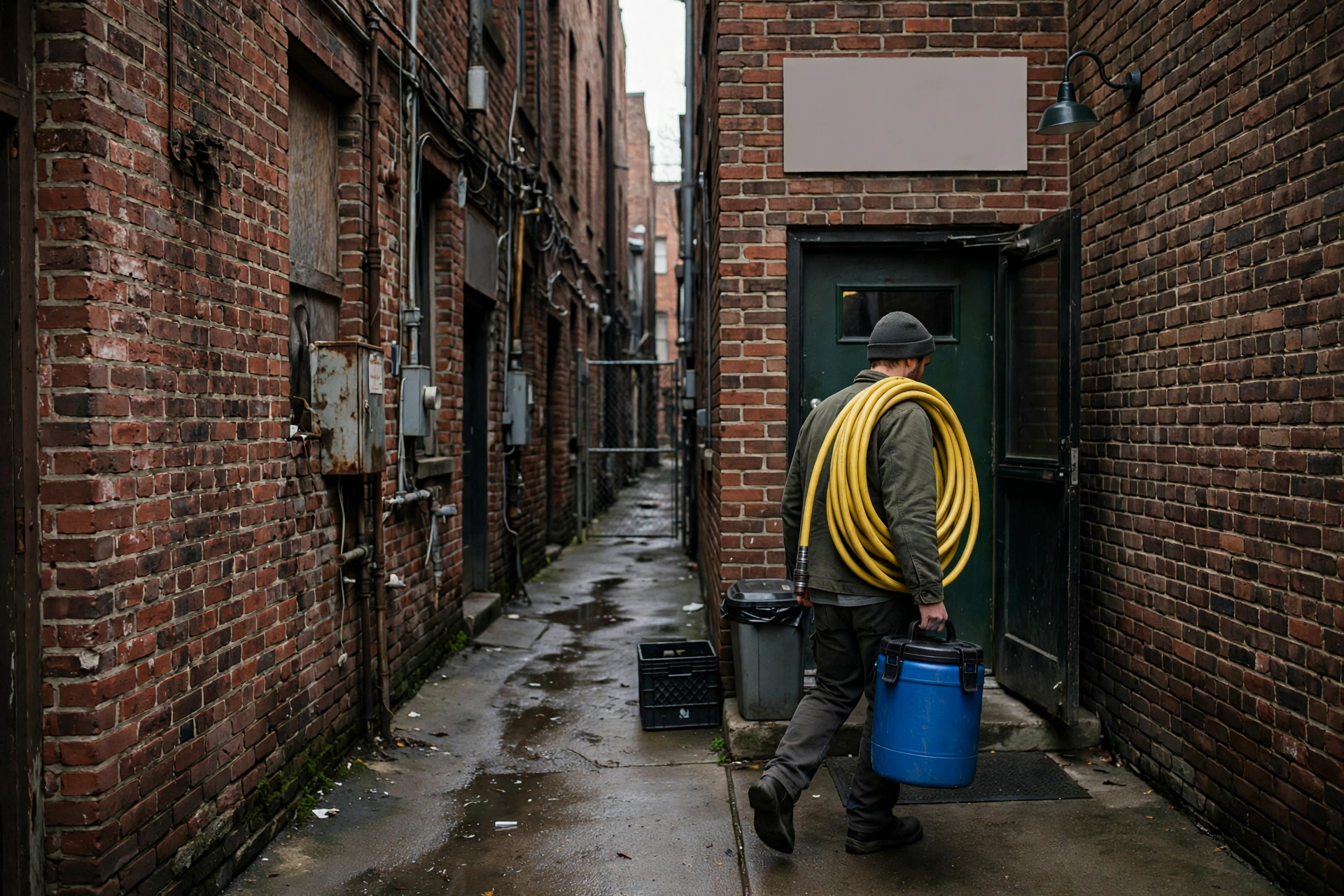
Back-of-house access in a downtown dining block is tight, so the crew plans the hose run before the visit.
What governs the work, stated plainly
Dearborn Grease Trap is based in Dearborn, and Dearborn has no FOG ordinance. There is no city trap-sizing table, no fixed pumping interval and no city manifest rule. Dearborn's own code sets one limit on grease discharge, 1,500 mg/L. The regional sewer authority, the Great Lakes Water Authority, has pretreatment rules that expect interceptors where required, regular cleaning at the owner's expense, and records kept and produced on demand. Those rules set no fixed interval.
This page does not state a Plymouth local rule, because we are not going to guess at one. Ask the sewer authority that serves your address what applies to your building. What we can say with confidence is how the waste is handled once it leaves your trap. Under Michigan's Part 121, trap clean-out residue is a regulated liquid industrial by-product. It may be hauled only by a registered and permitted transporter, on a shipping document for each shipment, and the kitchen keeps its own copies. Every visit we run follows that, and you keep the paperwork.
How often kitchens actually pump
The trade works from a simple benchmark: pump when grease and solids together reach about a quarter of the trap's capacity. It is a scheduling rule of thumb used by crews and by some municipal programs. It is trade practice and not law. Kitchens run to it at very different speeds:
High-volume kitchens commonly run every 4 to 6 weeks.
Moderate kitchens commonly run monthly to quarterly.
Low-volume kitchens commonly run every 3 to 6 months.
Those are what kitchens actually do, not requirements. Your menu sets your number. A kitchen that fries all day lands at the short end. A café with a small hot line lands at the long end. The first two visits tell us which.
Location · Plymouth
Featured job: a small downtown Plymouth restaurant
The story below follows one interior trap cleaning at a small downtown Plymouth restaurant, from the first call to the schedule that came out of it.
Chapter 1: The call
The kitchen manager at a small downtown Plymouth restaurant called about the prep sink. It had been draining slowly for a while, and a sour smell was coming up from the floor drain at close, strongest after a fried-food night. Nobody on the line could say when the trap under the dish station was last opened. The manager did not want a plumber to snake the line and leave. The aim was to find out what was in the trap and to stop guessing.
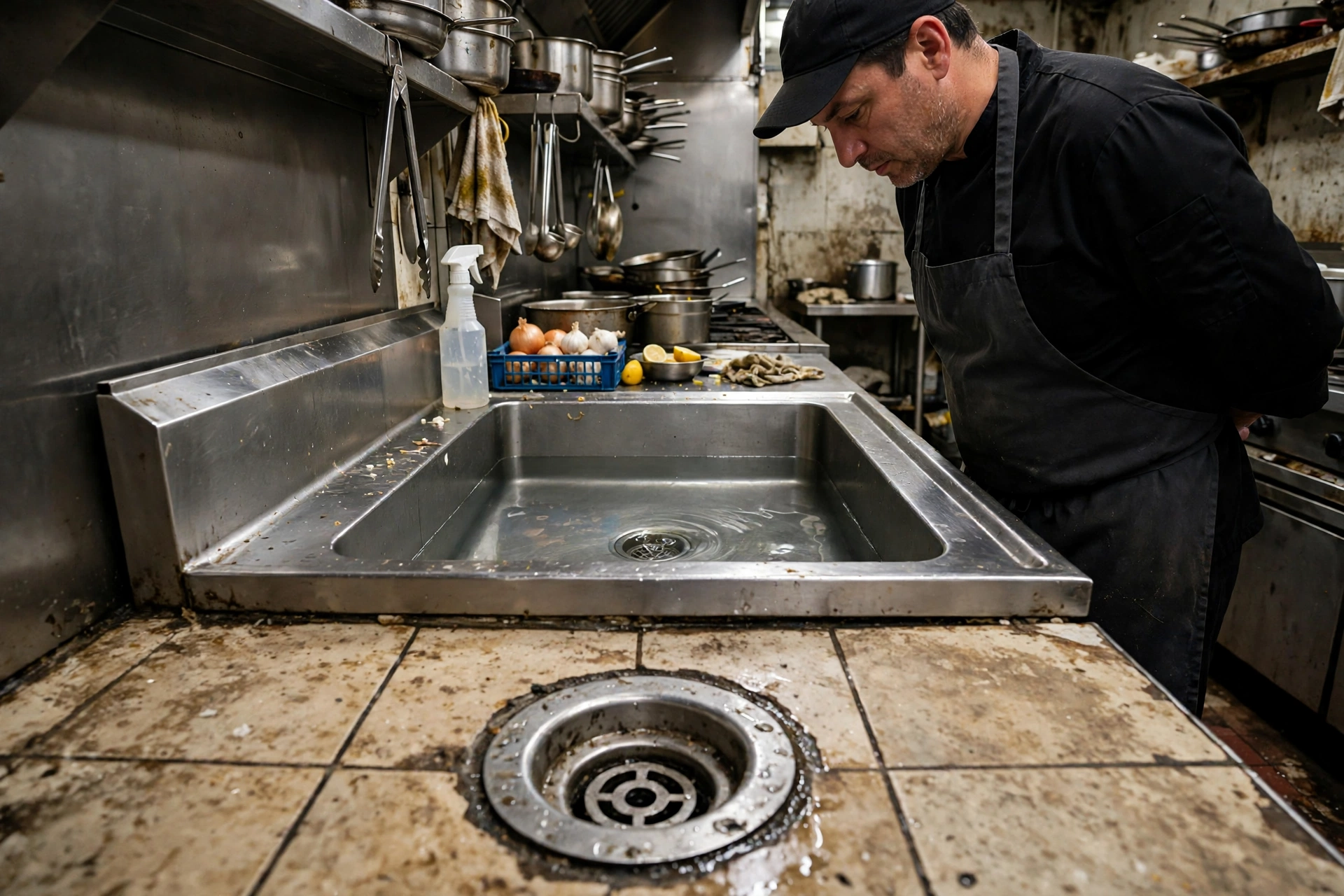
A slow prep sink and a smell at the floor drain were the first signs.
Chapter 2: What the crew found
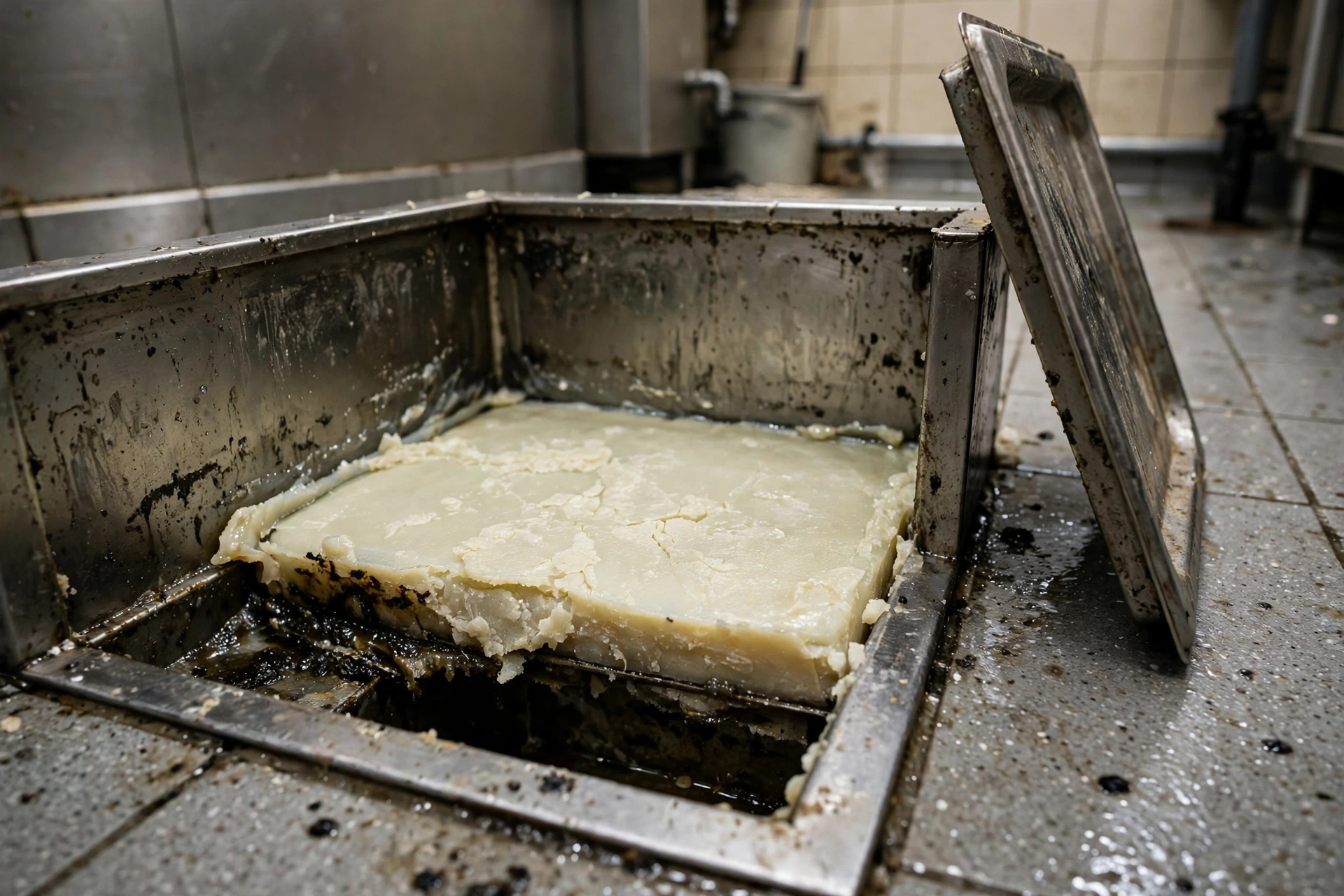
The crew lifted the lid on the small indoor trap under the dish station. The grease cap was thick and set, and the sludge layer below it had built well up the trap's depth. Measured against the quarter benchmark, the trap had passed the point where a crew would normally pump it. The baffle at the inlet was partly clogged, which explained the slow drain: wastewater had less room to move through.
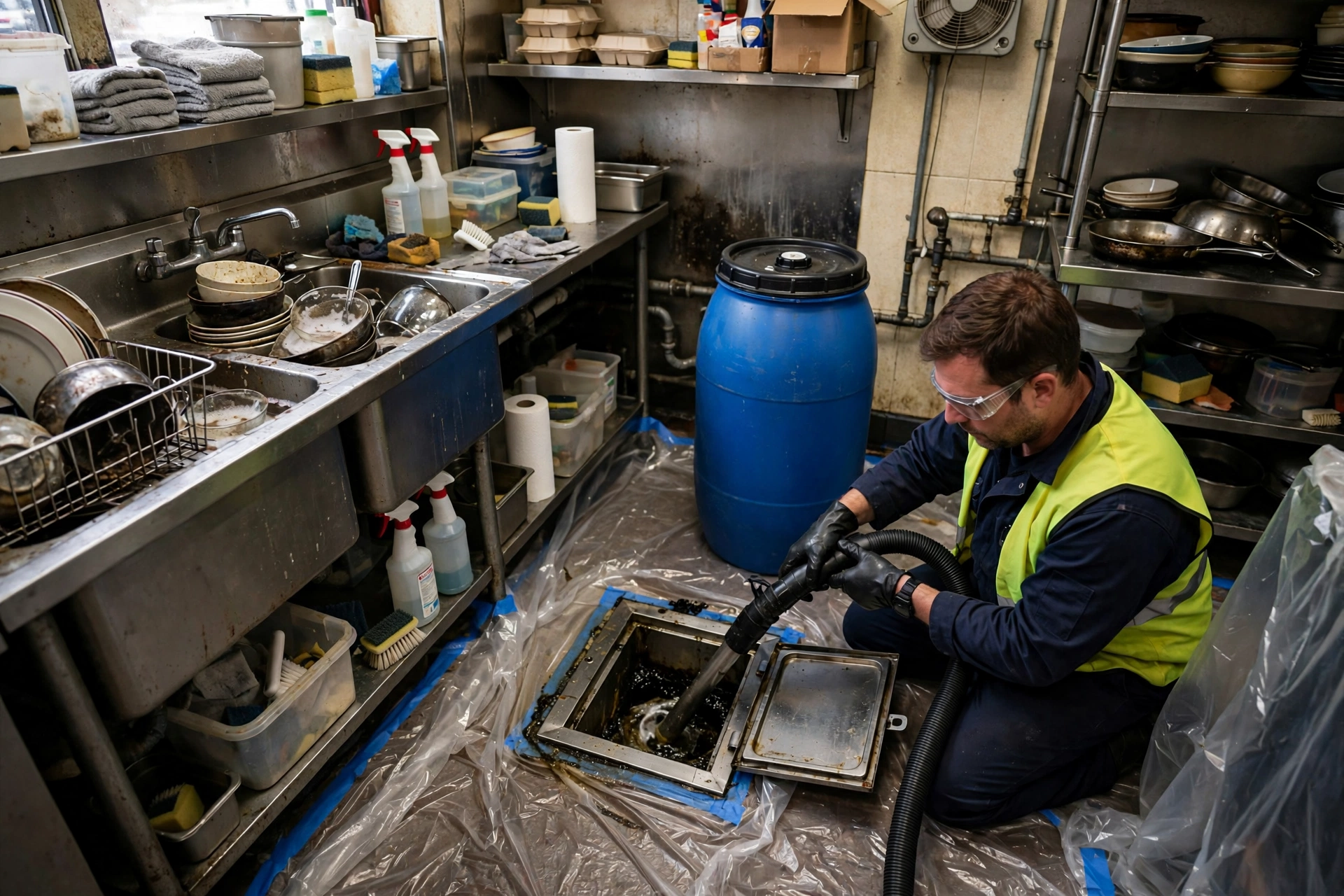
With the lid off, the grease cap and sludge layer showed how far the trap had filled.
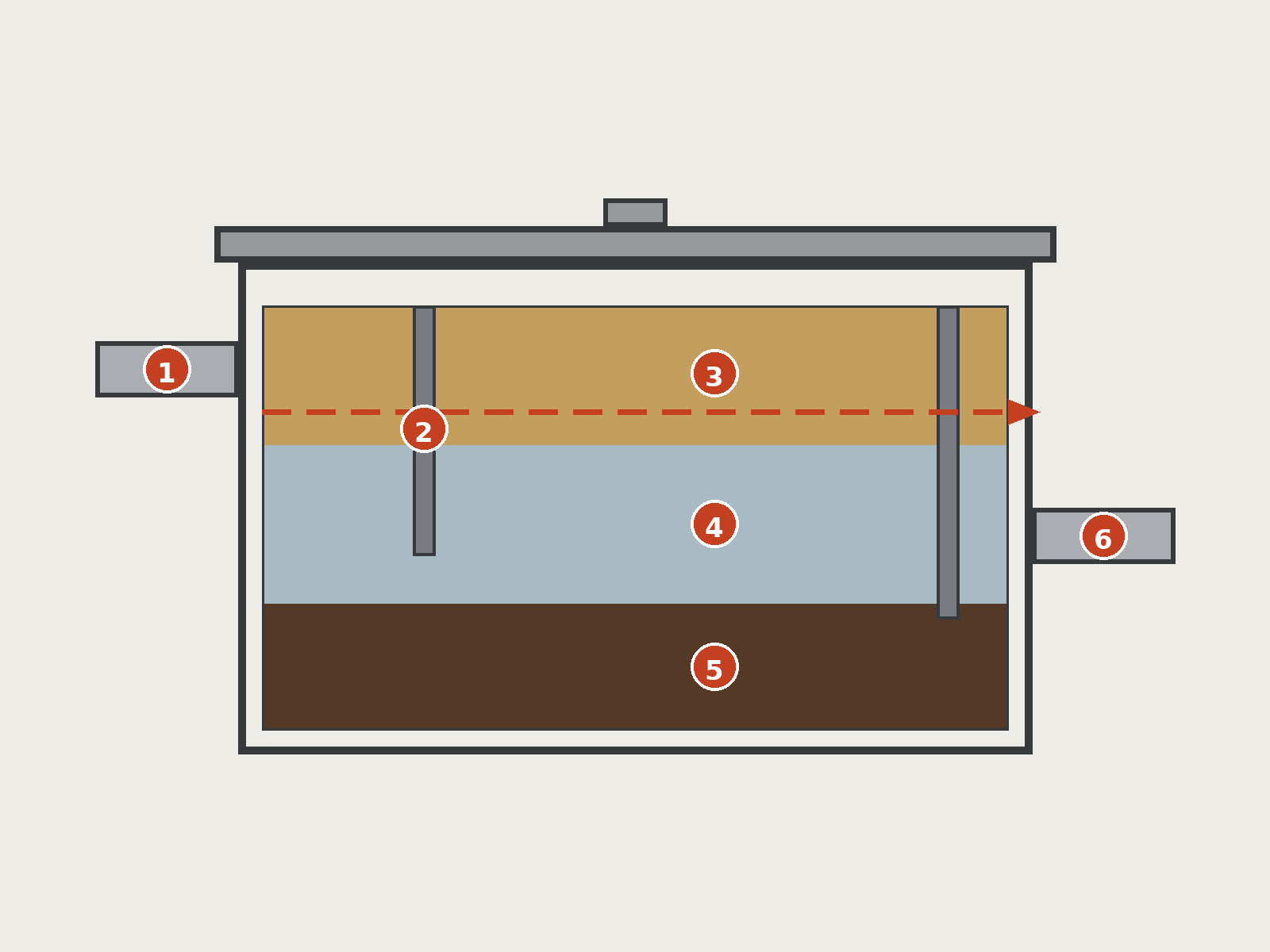
Grease cap and sludge layer: the trade's working benchmark is to pump when grease and solids together reach about a quarter of the trap's capacity. It is a scheduling rule of thumb, not law.
Baffle and inlet: a partly blocked baffle slows the line before the trap looks full, so the crew clears and inspects it on every visit.
Outlet: grease that passes the outlet goes to the sewer. Dearborn's own code limits grease discharge to 1,500 mg/L, and the regional sewer authority expects regular cleaning at the owner's expense, with records produced on demand and no fixed interval set.
Frequency check: a slider runs from high-volume to low-volume kitchens. It shows the working frequencies kitchens run: every 4 to 6 weeks for high-volume, monthly to quarterly for moderate, every 3 to 6 months for low-volume. A note states that these are working practice, not requirements.
Where it goes: the residue is a liquid industrial by-product under Michigan's Part 121, hauled by a registered and permitted transporter on a shipping document, with the kitchen keeping copies.
Price tag: a small indoor trap is $150 to $350 per service.
Chapter 3: The clean-out
The crew ran the hose, pumped the grease cap, liquid and sludge out of the trap, and scraped the walls and floor of the chamber. The inlet baffle was cleared and checked, and the lid and fittings were looked over for wear. The work happened at the dish station, away from the line, and the kitchen kept prepping through most of it. The charge was in the small indoor trap range, $150 to $350. Because the unit was small and accessible, nothing outside that range came into play.
The trap is pumped out and scraped clean, with the work held to the dish station.
Chapter 4: The record and the schedule
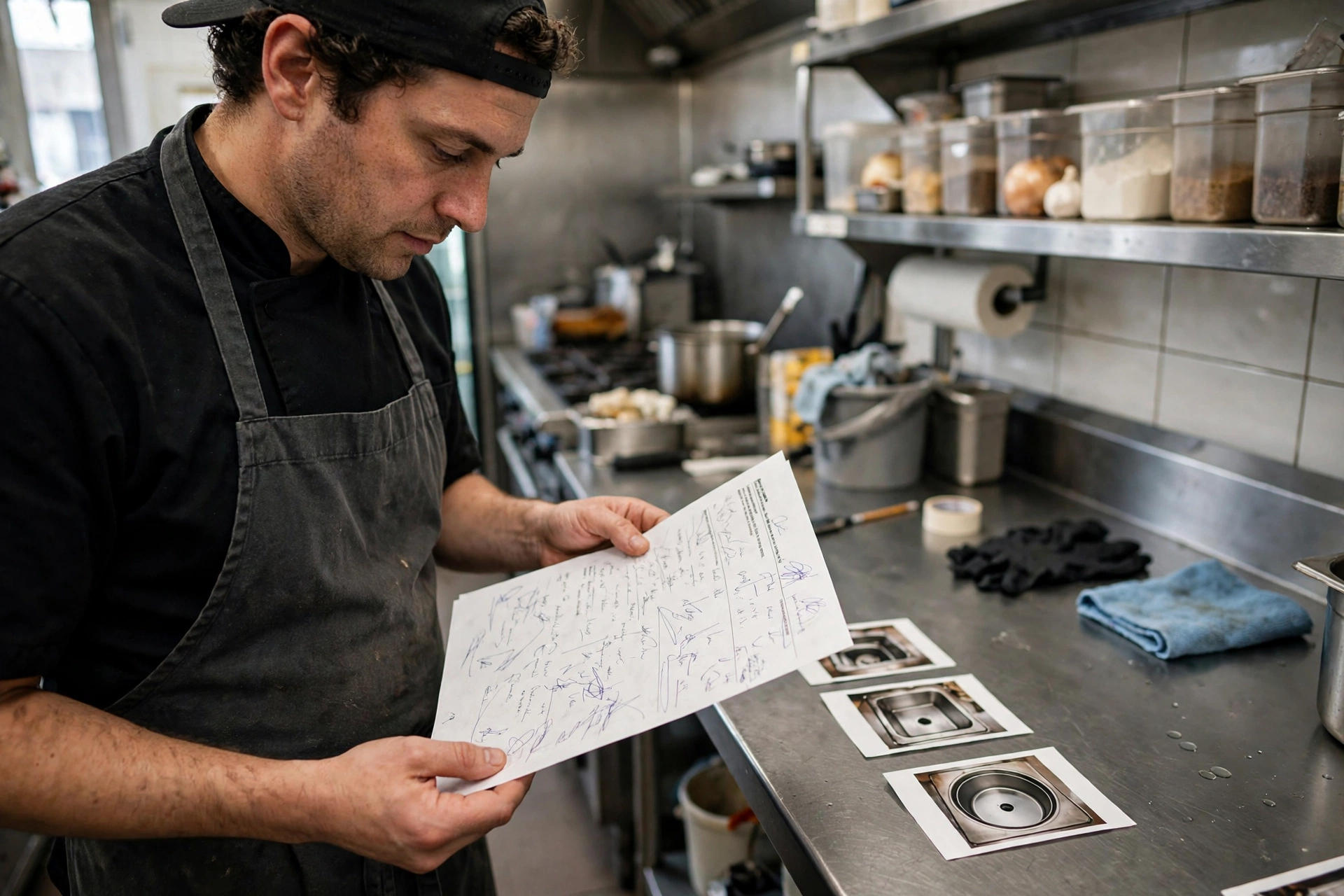
Before leaving, the crew photographed the clean trap and wrote up the service record: what was removed, the condition of the baffles and lid, and the transporter's shipping document for the waste. The manager kept copies. With a lighter fryer load than the first look suggested, the kitchen agreed to a recurring visit at the slower end of what kitchens run, with a check at each visit against the quarter benchmark. If the trap fills faster than planned, the schedule shortens. A few weeks later the prep sink was draining normally and the floor drain had stopped smelling.
The service record and photos stay with the kitchen, ready if anyone asks to see them.
Location · Plymouth
Talk to us about your trap
If this sounds like your kitchen, call (313) 351-8079. Tell us the size of the trap if you know it, where it sits, and what the kitchen fries. We will tell you what the visit looks like and where in the price range it lands.
Location · Plymouth
What the visit includes, what we document, what you keep
The visit includes:
pumping the grease cap, liquid and sludge out of the trap
scraping the interior
clearing and inspecting the baffles
checking the lid, fittings and the condition of the unit
line jetting where the line needs it, priced with the service visit it rides with
hauling the waste away through a registered and permitted transporter
The crew documents:
what was removed from the trap
the condition of the baffles, lid and unit
before and after photographs
the shipping document for the waste
You keep:
a copy of the service record
the shipping document
the photographs
a schedule matched to your kitchen's pace
Location · Plymouth
What it costs
These are our prices.
Service
Price
Interior grease trap cleaning, small indoor traps
$150 to $350
Medium traps
$300 to $600
Large exterior interceptors
$500 to $1,000 or more, by capacity and waste volume
Emergency call-out
one and a half to two times the standard service price
Used cooking oil collection
no charge for clean oil
Line jetting
priced with the service visit it rides with
Within a range, the price follows the trap's capacity, how easy it is to reach, and how much waste comes out. A short run from the door to the trap costs less than a long hose run through a basement. Most Plymouth kitchens in the walkable downtown run small indoor traps, so the first line is the one that applies. If your building has an exterior interceptor, the third line applies instead.
Location · Plymouth
When to call
Call when any of these shows up:
a prep sink or dish line draining slowly
a sour or rancid smell at a floor drain, especially after close
a backup, even a minor one
a trap nobody can say was ever opened
an inspection or notice from your sewer authority or health department
a change in menu, such as adding a fryer or extending hours
Call before the busy season, too. Winter deserves a note. One Dearborn-serving provider's published guidance says grease that stays semi-liquid in warm weather congeals as temperatures drop, so traps need more frequent checking in winter, not less. The same guidance notes that used oil freezes in outdoor bins, and the working fix is a bin swap: an empty bin delivered and the full one carried away. We collect clean used cooking oil at no charge.
A backup that cannot wait is an emergency call-out, priced at one and a half to two times the standard service price.
Location · Plymouth
Book your Plymouth service
Call (313) 351-8079, or send the form below. A short description of the trap and the kitchen is enough to start.
The form asks for: your name (required) and your phone number (required). Everything else is optional: business name, the kind of kitchen, what the trap is doing, and anything about access. A consent box is required before you send it.
The more details you give, the better we are able to help you.
Location · Plymouth
Questions
Do you really come out to Plymouth for small traps?
Yes. Plymouth's downtown kitchens are the kind that run small indoor traps, and interior grease trap cleaning is the service we have built this page around. It is about a 28 minute drive from Dearborn.
What does it cost to clean a small indoor trap in Plymouth?
Our price for small indoor traps is $150 to $350. Medium traps are $300 to $600. Where the price lands depends on the trap's capacity, how easy it is to reach, and how much waste comes out.
Is there a Plymouth rule that says how often I must pump?
We do not state a Plymouth rule on this page, and we will not guess at one. Ask the sewer authority that serves your address what applies to you. For reference, Dearborn has no FOG ordinance, no fixed interval and no sizing table.
What is the quarter rule?
It is the trade's working benchmark: pump when grease and solids together reach about a quarter of the trap's capacity. It is a scheduling rule of thumb used by crews, not a law.
How often do kitchens actually pump?
Working practice runs about every 4 to 6 weeks for high-volume kitchens, monthly to quarterly for moderate ones, and every 3 to 6 months for low-volume ones. Those are what kitchens run, not requirements. Your menu and your fryer load set your number.
Do I have to close the kitchen?
Interior trap cleaning is a contained visit at the trap, and kitchens usually keep working through it. If your trap sits in a spot that blocks the line, tell us when you call and we will plan around it.
What happens to the grease you take out?
It is a liquid industrial by-product under Michigan's Part 121. It is hauled by a registered and permitted transporter on a shipping document, and you keep copies. A septage licence does not cover this waste.
What paperwork do I get?
A service record covering what was removed and the condition of the baffles and lid, before and after photos, and the shipping document for the waste. These are yours to keep.
Will the sewer authority ask to see records?
The Great Lakes Water Authority's pretreatment rules, which cover Dearborn's sewer customers, let the authority require records of inspection, cleaning and maintenance. They set no fixed interval. Keeping your service records and shipping documents is how a kitchen shows regular cleaning. Ask your own authority what applies at your address.
What if my trap backs up between visits?
Call (313) 351-8079. An emergency call-out is priced at one and a half to two times the standard service price. A backup also tells us the schedule needs shortening, and we adjust it with you.
Do you collect used cooking oil?
Yes. Collection of clean oil is at no charge. We can bundle it with a trap visit.
Does winter change anything?
One Dearborn-serving provider's published guidance says grease congeals in cold weather and traps need more frequent checking in winter, not less. We watch the trap against the quarter benchmark at each visit, and we shorten the schedule when it fills faster.
Can you jet my drain line too?
Yes, where the line needs it. It is priced with the service visit it rides with, not as a separate job.
What if my building has an exterior interceptor instead?
Large exterior interceptors are $500 to $1,000 or more, by capacity and waste volume. Tell us what you have when you call and we will sort out the visit.